Video & Displays
Mini-LED vs. OLED: Which TV Is Right for Your Room?
Brightness, black levels, blooming, glare, viewing angle, burn-in, gaming, sizes and price per inch, with measured numbers from the TVs we recommend and a decision by room.
We may earn a commission when you buy through links on this site, at no extra cost to you. It never affects what we recommend. Learn more.
Mini-LED and OLED are the two ways to get a great picture in 2026, and they get there from opposite directions. An OLED lights each pixel on its own, so black is truly black and the picture holds up from any seat, but it tops out at a fraction of a Mini-LED's brightness. A Mini-LED is an LCD with thousands of tiny backlights behind it, so it gets searingly bright and comes in huge sizes for the money, but the backlight can never switch off a single pixel. Which one is right depends on how much light is in your room, how far from the center of the couch people sit, and how big a screen you want. This guide works through each factor with measured numbers from the TVs we recommend, then gives the decision by room.
How each one makes a picture
A Mini-LED TV is an LCD. A layer of liquid crystals shutters light from a backlight, and the backlight is made of thousands of miniature LEDs grouped into dimming zones that brighten and darken independently. More zones means the backlight can follow the picture more closely. A 65-inch QM7L has about 1,150 zones; a QM8L has up to 4,000. Quantum dots in front of the backlight widen the color.
An OLED TV has no backlight. Each of its 8.3 million pixels is its own light source and can switch fully off. That is why an OLED's black is perfect and its contrast is effectively infinite. The trade is brightness: an organic pixel cannot be driven as hard as an LED backlight, and the panel dims large bright areas to protect itself. The two OLED types differ a little: LG's WOLED (used in the C6) adds a white sub-pixel for brightness, while QD-OLED (the Samsung S90F and Sony BRAVIA 8 II) uses quantum dots for wider color at the cost of a missing polarizer, which matters in bright rooms.
Brightness: Mini-LED, by a wide margin
Brightness is measured in nits on a 10 percent window, a bright square on a black background that mimics an HDR highlight such as a sun glint or a streetlight.
| TV | Type | Peak HDR brightness (10% window) |
|---|---|---|
| TCL QM8L | Mini-LED | About 3,720 nits (Tom's Guide) |
| Hisense U7SG | Mini-LED | About 2,870 nits (Tom's Guide) |
| TCL QM7L | Mini-LED | About 2,270 nits (Tom's Guide) |
| Sony BRAVIA 8 II | QD-OLED | About 1,500 to 1,800 nits |
| LG C6 | WOLED | About 1,300 to 1,500 nits |
| Samsung S90F | QD-OLED | About 1,300 to 1,500 nits |
Two things follow from the table. First, every Mini-LED here is brighter than every OLED, and the budget QM7L still out-brightens the 2,700-dollar BRAVIA 8 II. Second, OLEDs are no longer dim. A 1,300-nit highlight is vivid in any room with the curtains drawn, and the 2026 OLEDs hold their brightness on larger areas better than their predecessors. Where the gap shows is a sunlit room in the afternoon, where a Mini-LED's extra headroom keeps the picture punchy while an OLED looks a little flat. For daytime sports in a bright family room, Mini-LED is the right tool.
Black level and contrast: OLED, by a wider one
Turn the lights off and the order reverses. An OLED's black pixels are off, so a starfield is pinpoints of light on true black, and the letterbox bars of a movie vanish into the bezel. A Mini-LED's zones are far larger than a pixel: on a 65-inch QM7L each of its roughly 1,150 zones covers about 7,000 pixels. When a bright object sits on a dark background, the whole zone has to lift, and a soft halo appears around subtitles, credits, a candle or a moon. More zones shrink the halo, and the QM8L's 4,000 zones make it subtle, but no backlight eliminates it.
In a dark dedicated theater this is the difference you will see every night. In a lit living room, where the ambient light raises the black level anyway, it matters far less. That is the whole decision in two sentences.
Glare and reflections
This one is about coatings as much as technology. The Hisense U7SG has a matte anti-reflection screen that scatters windows and lamps into a soft haze, and RTINGS rates it the best of these TVs for a bright room. The TCLs and the LG C6 are glossy with anti-reflective coatings, which handle lights off to the side but mirror anything facing the screen.
QD-OLED has a specific weakness here. The Samsung S90F and Sony BRAVIA 8 II panels have no polarizer, so under strong room light their blacks lift to a purple-gray. In a dim room they are the richest pictures in this guide; in a room with windows facing the screen, the LG C6 holds its blacks better and a matte Mini-LED beats both.
Viewing angle
OLED pixels emit light in every direction, so the picture looks the same from the end of a wide sectional as from the middle. The Mini-LEDs here use VA-type LCD panels, which lose contrast and saturation as you move off-center; by 30 to 40 degrees the picture visibly washes out. The TCL QM8L adds a wide-angle filter that helps, and the Hisense and the QM7L do not.
If your seats spread across the room, or people watch from a kitchen island off to the side, OLED earns its price on this alone.
Burn-in and longevity
Burn-in is the fear that keeps people on LCD, and it is largely out of date for mixed use. Modern OLEDs shift the image slightly, dim static logos, and run a pixel-refresh cycle when the TV is off. RTINGS' long-running burn-in test shows that varied content, which is what most households watch, leaves no visible marks over years. The remaining risk is many hours a day of the same static content: a news ticker, a desktop taskbar, or one game's HUD, every day, for years.
A Mini-LED cannot burn in. Its LCD layer does not wear with the image, and its backlight dims evenly with age. For a TV that will spend eight hours a day on a news channel, or double as a PC monitor, that is the deciding fact.
For a GTA 6 or sports setup, both are fine: the minimap and scoreboard are static, but the rest of the picture is not, and the built-in protections handle it. Our best TV for PS5 and Xbox roundup goes deeper on that.
Gaming
On paper they are even. Every TV in this guide runs 4K at 120 Hz or more with VRR and ALLM, and the input lag is within a millisecond or two of each other: about 9 ms on the Samsung S90F, under 10 ms on the LG C6, 9.4 ms on the QM7L, 9.5 ms on the QM8L and 9.8 ms on the U7SG. Port counts vary more than panel type: the C6, S90F, U7SG and QM8L have four HDMI 2.1 inputs, the QM7L and BRAVIA 8 II have two.
Where OLED pulls ahead is motion. Its pixels change state almost instantly, so fast panning stays sharp, while VA Mini-LED panels smear slightly; RTINGS calls the QM7L's motion blurry in game mode. Where Mini-LED pulls ahead is HDR games in a bright room, and the no-burn-in freedom to leave a game paused for an hour. Xbox owners who want Dolby Vision gaming should note that the LG C6 supports it and the Samsung has no Dolby Vision at all; see our best TV for Xbox Series X picks.
Sizes and price per inch
This is Mini-LED's second big advantage. OLED panels run from 42 to 83 inches in the C6 and S90F lines, and the 97-inch OLEDs cost as much as a car. Mini-LEDs run from 55 to 100 inches, and the price climbs gently.
| 65-inch model | Type | Typical price |
|---|---|---|
| TCL QM7L | Mini-LED | About $900 |
| Hisense U7SG | Mini-LED | About $1,000 |
| Samsung S90F | QD-OLED | About $1,400 |
| LG C6 | WOLED | About $1,600 |
| Sony BRAVIA 8 II | QD-OLED | About $2,700 |
| Large sizes | Type | Typical price |
|---|---|---|
| Hisense U7SG 85-inch | Mini-LED | About $1,700 |
| TCL QM8L 85-inch | Mini-LED | About $2,500 |
| TCL QM8L 98-inch | Mini-LED | About $3,000 |
| LG C6 83-inch | WOLED | About $3,500 on sale ($5,300 list) |
At 65 inches an OLED costs about 500 dollars more than a comparable Mini-LED. At 83 to 85 inches the gap is about 1,000 dollars when the OLED is on sale and closer to 3,000 at list price, and past 85 inches OLED is not an option at all. If the TV size calculator says your couch wants 85 inches or more, the decision has already been made for you. The room size calculator works it out from the room's dimensions.
Which one for your room
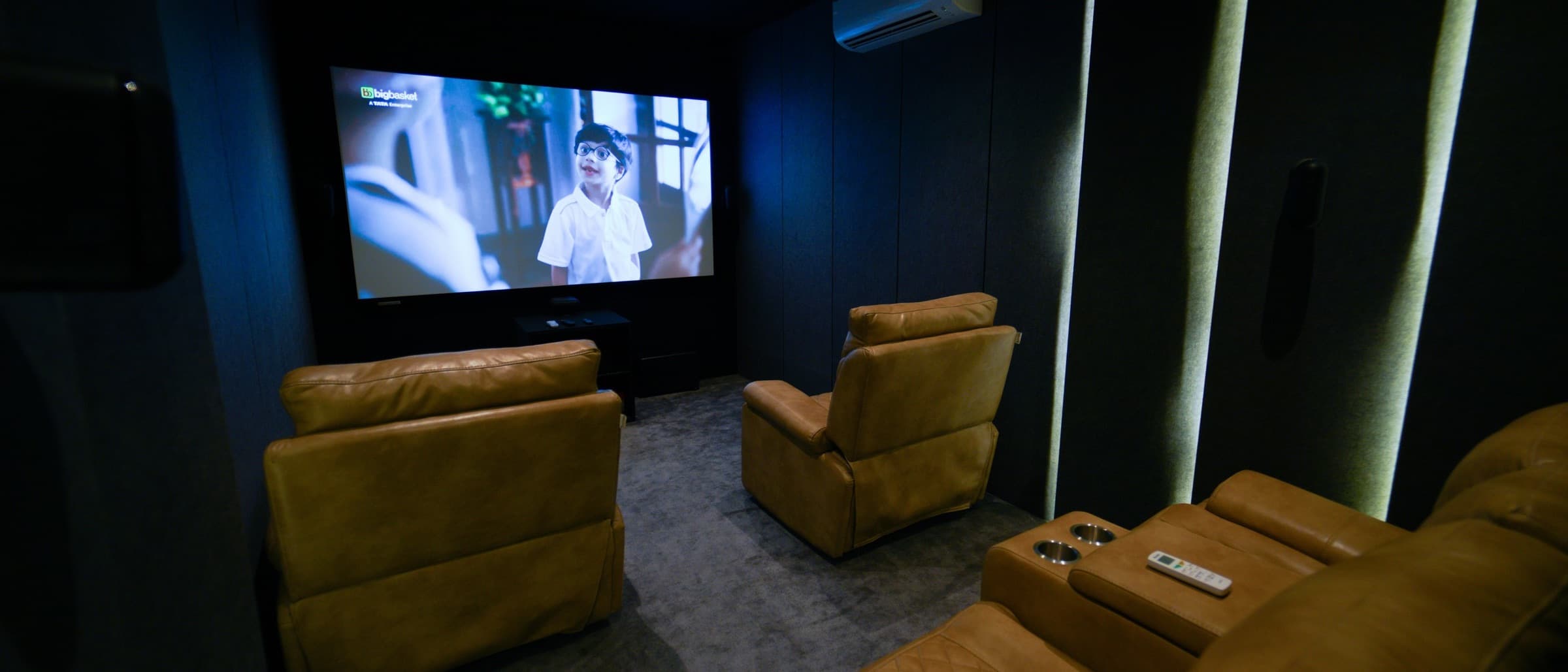
- Dark dedicated theater, or a living room where you watch with the lights down. OLED. Perfect blacks are the point of a dark room, and halos are what you would notice on a Mini-LED. The LG C6 is the all-rounder; the Samsung S90F has richer color for less, with no Dolby Vision. Our best 65-inch TV for a dark room roundup ranks them.
- Bright family room, daytime sports, windows facing the screen. Mini-LED, and preferably the matte Hisense U7SG. Brightness and the coating beat perfect blacks you cannot see in daylight. Our best TVs for a bright room roundup has the alternatives.
- Mixed use, evenings mostly, one couch straight in front. Either, so buy on price. A QM7L gives you 90 percent of the picture for 500 dollars less than a C6; the C6 gives you the blacks and the viewing angle. Our LG C6 vs Hisense U7SG and TCL QM7L vs LG C6 comparisons are the two most common versions of this exact choice.
- A wide sectional, or seats off to the side. OLED, for the viewing angle. If the room is also bright, the TCL QM8L with its wide-angle filter is the Mini-LED compromise.
- 85 inches or bigger. Mini-LED. The QM8L at 85 inches costs about 1,000 dollars less than an 83-inch OLED on sale, and it goes to 98 inches.
- News all day, a PC monitor, or a single game for years. Mini-LED, for the burn-in immunity.
- Under 1,000 dollars at 65 inches. Mini-LED. There is no OLED at that price; our best budget Mini-LED TV roundup covers the field.
Frequently asked questions
Is Mini-LED better than OLED? Neither is better; they are better at different things. Mini-LED wins on brightness, size for the money and burn-in immunity. OLED wins on black level, contrast, viewing angle and motion. Match the strengths to your room.
Is OLED worth the extra money? In a dark room, yes: the black level and the lack of halos are visible every night. In a bright room, usually not, because ambient light hides the OLED's advantages and the Mini-LED's brightness is what you see.
Does OLED still burn in? It can, under hours a day of the same static image for years. With varied viewing and the built-in protections left on, it is not a practical concern for a living-room TV in 2026.
Which is better for gaming? Both have input lag under 10 ms and 120 Hz or faster with VRR. OLED has sharper motion; Mini-LED has brighter HDR and no burn-in worry. For a bright room or many hours of one game, Mini-LED; for a dark room, OLED.
What about QLED? QLED is a quantum-dot LCD without Mini-LED backlighting, so it has the color but far fewer dimming zones, often none. A Mini-LED is the QLED worth buying; a plain QLED is a budget step below both of the TVs in this guide.
Is QD-OLED better than WOLED? QD-OLED has wider color and a little more brightness; WOLED handles bright rooms better because it keeps its polarizer, and LG's sets add Dolby Vision, which Samsung's do not. Our Samsung S90F vs LG C6 comparison settles it model by model.
Get new guides in your inbox
One email when we publish something worth reading. No spam.